Margin Trading and the Myth of Easy Gains: A Disciplined Framework for Surviving Leverage in Crypto

Every week, thousands of retail traders open leveraged positions in cryptocurrency markets with a clear goal: accelerate their gains. Every week, a significant portion of those same traders watch their accounts liquidated within hours. The appeal is understandable. A 10x leveraged position on a 5% Bitcoin move generates a 50% return. What that same calculation rarely advertises is the inverse: a 10% adverse move eliminates the entire position. At King88 Group, we believe leverage is not inherently destructive — but the way most retail traders approach it certainly is.
This piece does not advocate for reckless speculation. It advocates for clarity, discipline, and the kind of structural thinking that separates a professional trader from someone chasing a shortcut.
The Mechanics Behind the Massacre
Margin trading allows a trader to control a position larger than their available capital by borrowing funds from an exchange. A $1,000 account using 20x leverage controls a $20,000 position. The exchange, protecting its own exposure, sets a liquidation threshold — the price point at which the borrowed funds are automatically recovered.
On a 20x leveraged long position, a move of roughly 4–5% against the trader triggers full liquidation. In a market where Bitcoin routinely swings 3–8% within a single trading session, that margin for error is essentially nonexistent.
The problem is compounded by funding rates. On perpetual futures contracts — the most commonly used leverage vehicle in crypto — traders holding positions overnight pay a recurring fee based on market sentiment. During bullish periods, long positions pay shorts. During extended rallies, those funding rates can quietly erode a position even when price moves favorably.
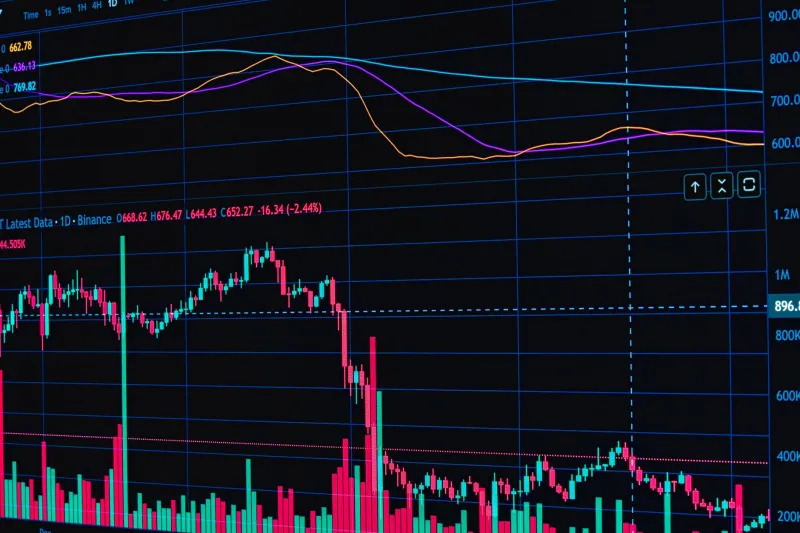
In 2021, during a single 24-hour period following Bitcoin's peak near $65,000, over $8 billion in leveraged positions were liquidated across major exchanges. Individual traders who had opened positions at 25x or higher lost everything in minutes. These were not isolated incidents of naivety — many were experienced traders who had simply misjudged volatility timing.
The Psychology Driving the Losses
Beyond mechanics, the real engine behind retail liquidations is behavioral. Three psychological patterns dominate.
Overconfidence following early wins. A trader who catches a leveraged position correctly once develops an inflated sense of their own predictive ability. They increase position size. They reduce their caution. The market, indifferent to personal narratives, eventually corrects that assumption violently.
Loss aversion and the refusal to cut. When a leveraged position moves against a trader, the rational response is to close it and accept a defined loss. The emotional response is to hold, to hope, to add to the position — a behavior known as "averaging down" on a leveraged trade. In spot markets, averaging down can sometimes work. In leveraged markets, it accelerates liquidation.
The illusion of control through leverage size selection. Traders frequently choose leverage multiples — 5x, 10x, 25x — based on how much they want to make, not based on market volatility or their actual risk tolerance. This is backwards. Leverage should be determined by the trade setup and the acceptable loss, not by the desired profit.
A Position Sizing Framework That Actually Holds
Professional traders do not ask "how much can I make?" They ask "how much can I lose, and is that acceptable?" This reframe is fundamental.
A practical framework for disciplined leverage trading begins with the 1% rule: no single trade should risk more than 1% of total account equity. On a $10,000 account, that is $100 at risk per trade.
From that risk ceiling, work backward. If you are trading Bitcoin with a stop-loss placed 3% below entry, and your maximum loss is $100, then your position size should be approximately $3,333 in notional value. If you choose to apply 3x leverage, you deploy $1,111 of your own capital to control that position. If you apply 10x leverage, you deploy $333.
The leverage multiple, in this framework, becomes almost incidental. What matters is the dollar risk, the stop placement, and the position size — in that order.
Additionally, serious traders maintain a maximum concurrent exposure rule. No more than three leveraged positions open simultaneously. No more than 10–15% of total account equity deployed in leveraged trades at any given time. The remainder stays in spot holdings or stable assets, insulated from cascading liquidation events.
Rules for Traders Who Refuse to Be Casualties
Beyond framework, discipline requires operational rules that do not bend under pressure. At King88 Group, we suggest the following as a baseline for anyone trading with leverage:
- Set your stop-loss before entering the trade. Not after. Not when the position moves against you. Before.
- Never move a stop-loss further away from entry. Tightening a stop is acceptable. Widening it to avoid a loss is a behavioral failure.
- Do not trade leveraged positions during major macroeconomic announcements. Federal Reserve rate decisions, CPI releases, and geopolitical events create volatility spikes that have nothing to do with technical analysis.
- Keep a written trade log. Emotion fades; documentation does not. Reviewing past decisions — both wins and losses — is the most underutilized tool in retail trading.
- Treat a liquidation as a structural failure, not bad luck. If a position gets liquidated, the question is not "why did the market do that?" The question is "why was my stop not in place?"
Leverage as a Tool, Not a Shortcut
The traders who consistently generate returns using leverage share one common trait: they do not use it to get rich quickly. They use it to modestly amplify well-researched positions while keeping losses bounded and predictable.
The "get rich quick" mentality is not a trading strategy. It is a disposition toward gambling — and the crypto market is an exceptionally efficient mechanism for separating undisciplined capital from its owners.
Leverage, used within a rigorous framework, is a legitimate and powerful instrument. But it demands more discipline, not less. It requires a trader to know exactly what they are willing to lose before they consider what they might gain.
At King88 Group, we believe the traders who endure — and ultimately rule their chains — are not the ones who take the biggest positions. They are the ones who survive long enough to compound.